Essay · Biotechnology
Biotech Investing — Eleven Years Later
AI and the Changing Economics of Drug Development
Eleven years after Biotech Investing — Five Basic Questions to Ask, a retrospective on what the 2015 thesis got right and missed, and an emerging thesis: AI may change the organization and economics of drug development, not just the science.
Edited by Karl B. Douglas
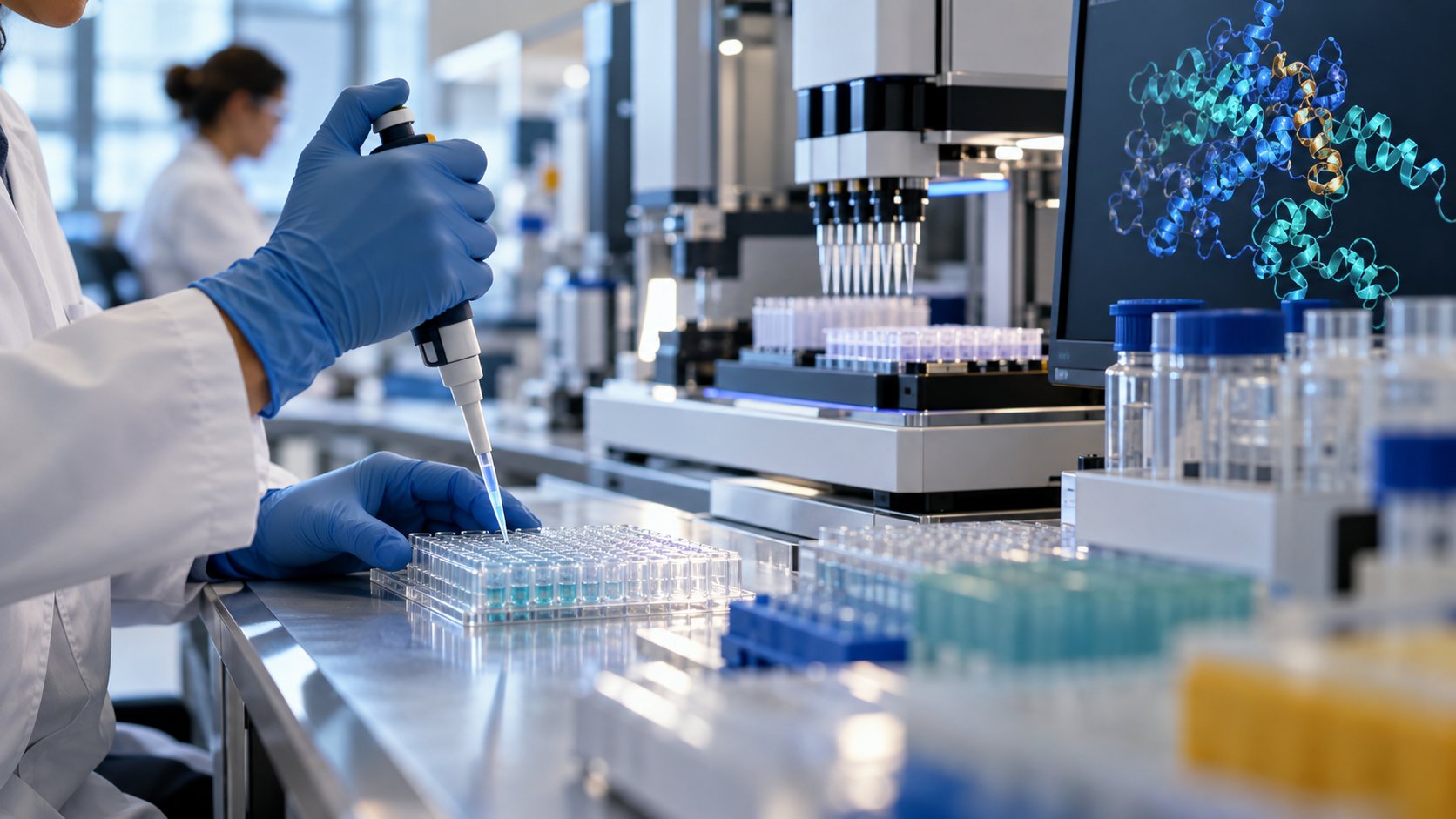
In September 2015, I wrote Biotech Investing — Five Basic Questions to Ask. There was a great deal of enthusiasm in biotech at the time, and the obvious question was whether we were looking at another market bubble or something more fundamental.
My view was that the research process itself was changing. High throughput screening, bioinformatics and more efficient genome sequencing were converging with historically cheap computing power. More compounds could be tested, more information could be searched, and researchers could work through problems that previously consumed enormous amounts of time.
Eleven years later, I think the direction of that thesis held up. That doesn't mean every biotech investment worked, or that better research tools justified every valuation. And I didn't predict AlphaFold or the protein design systems we have today.
But the convergence continued. What interests me now is where it leads.
AI may change the organization and economics of drug development, as well as the science. If that happens, it also changes how we should view biotech investing.
The Continuum
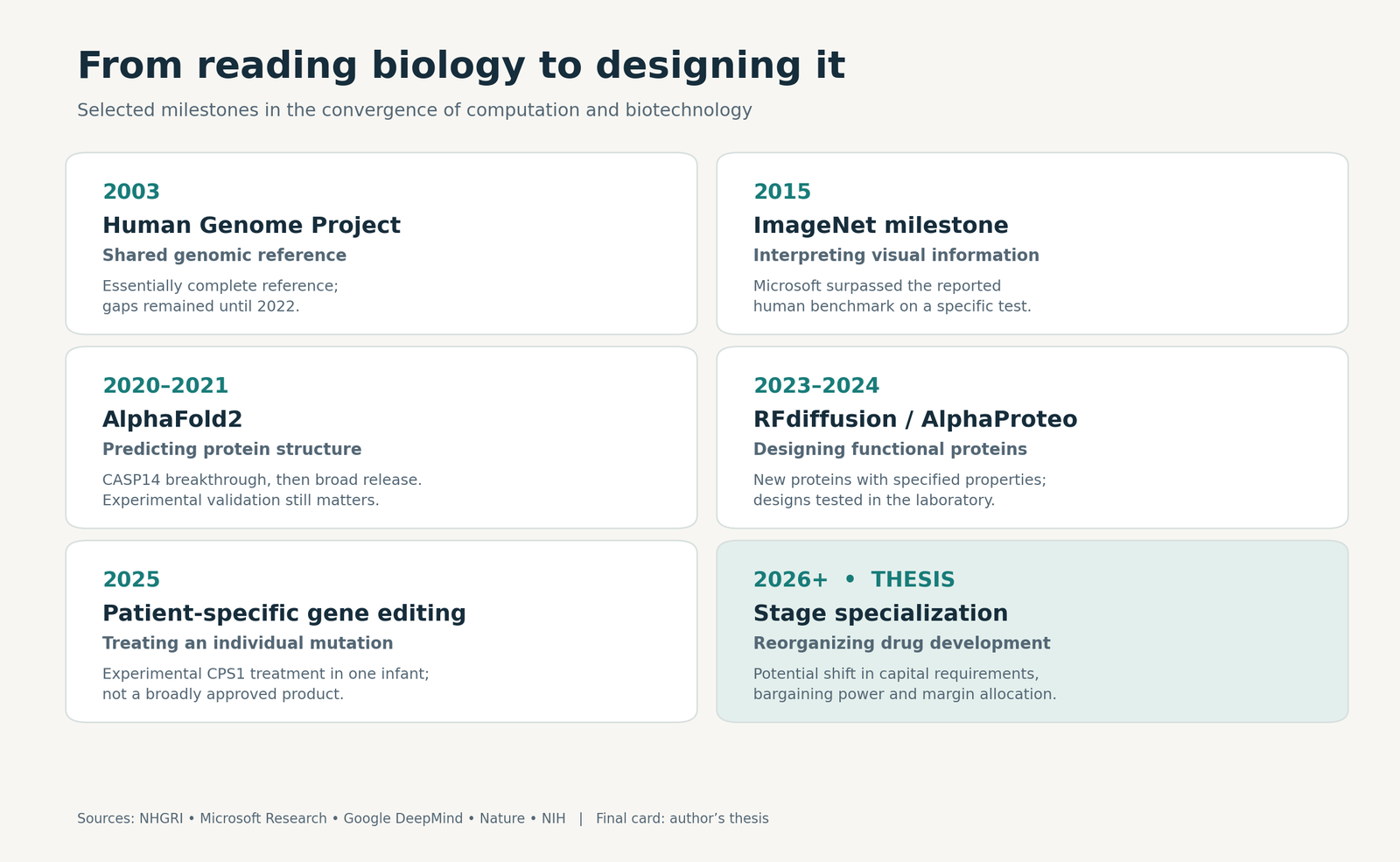
It helps to look at the progression over time. These are selected milestones, not a claim that biology or computational research began in 2003. Nor did one breakthrough directly cause all the others. They illustrate capabilities accumulating, and eventually reinforcing each other.
2003 — A reference for the human genome
The Human Genome Project was declared complete, providing an essentially complete reference sequence. It covered roughly 92% of the genome; a gapless reference followed in 2022. The significance was a foundation researchers could share, compare and build upon. Reading the sequence was an extraordinary accomplishment. Understanding what it did was a much larger task. [1]
2015 — Computers cross an image recognition benchmark
Microsoft reported that its computer vision system surpassed the reported human benchmark on ImageNet's 1,000-category classification task. Its error rate was 4.94%, compared with the reported human rate of 5.1%. This was a specific test, not proof that computers could see better than people in every setting. Still, it was a meaningful signal. Advances in imaging, automated measurement and the ability to interpret images were becoming part of the same computational convergence. [2]
2020–2021 — Protein structure prediction changes
AlphaFold2's breakthrough at the CASP14 assessment in 2020, followed by the release of the system and structure database in 2021, substantially reduced a major research bottleneck. Experimental methods such as X-ray crystallography could involve months or years of work. For many proteins, researchers could now begin with a useful predicted structure rather than wait for an experimental one. AlphaFold did not eliminate crystallography or the need to verify important structural details. It changed the starting point, and could also help solve experimental structures. [3]
2023–2024 — From predicting proteins to designing them
RFdiffusion and subsequently DeepMind's AlphaProteo demonstrated another step: generating new proteins with specified properties, including binding to selected targets, and testing those designs experimentally. Predicting the shape of an existing protein and proposing a new protein to perform a desired function are different capabilities. A designed binder is not yet a medicine. But this moves computation further into the creation of potential therapeutic building blocks. [4, 5]
2023 — Gene editing reaches an approved treatment
Alongside these computational advances, the FDA approved Casgevy, the first FDA-approved therapy using CRISPR/Cas9. The treatment modifies a patient's blood stem cells outside the body. It is a separate technological progression, but an important example of the expanding biological toolkit that computational research can work with. [6]
2026 and beyond — A potential change in industry structure
The next part of the timeline is my investment thesis, rather than an accomplished scientific milestone. As discovery capabilities improve, drug development may become more specialized by stage. The organizations producing an idea, validating it, developing it clinically and bringing it to market may increasingly be different businesses.
What I Saw, and What I Missed
The original article was primarily about research productivity and capital. I believed the convergence of technologies was increasing the rate of discovery, and that investors needed to understand both the science and the financing required to advance it.
That was useful. But it was only part of the picture.
I underestimated how far computation would move from searching and analyzing biological information into generating new possibilities. Protein structure prediction was a major advance. The ability to design proteins against a particular target takes the idea further.
I also think we need to be careful about the conclusions we draw from that progress. Better prediction of a structure does not establish that a treatment will work. Better binding does not establish that it will reach the right tissue, be safe, or produce a meaningful benefit in a patient.
The wet lab remains critically important. So do clinical trials, manufacturing and the people who understand how to run them.
I avoid the temptation to treat biology as simply a data problem. The models learn from experimental knowledge, and their proposals have to return to experiments. A company that can generate useful data, learn from it and test the next proposal has something more substantial than access to a model.
The practical question is whether the company can turn computational capability into biological evidence. And then turn that evidence into an asset someone will finance, license or buy.
How the Drug Pipeline May Change
This is where I think the investment discussion becomes more interesting.
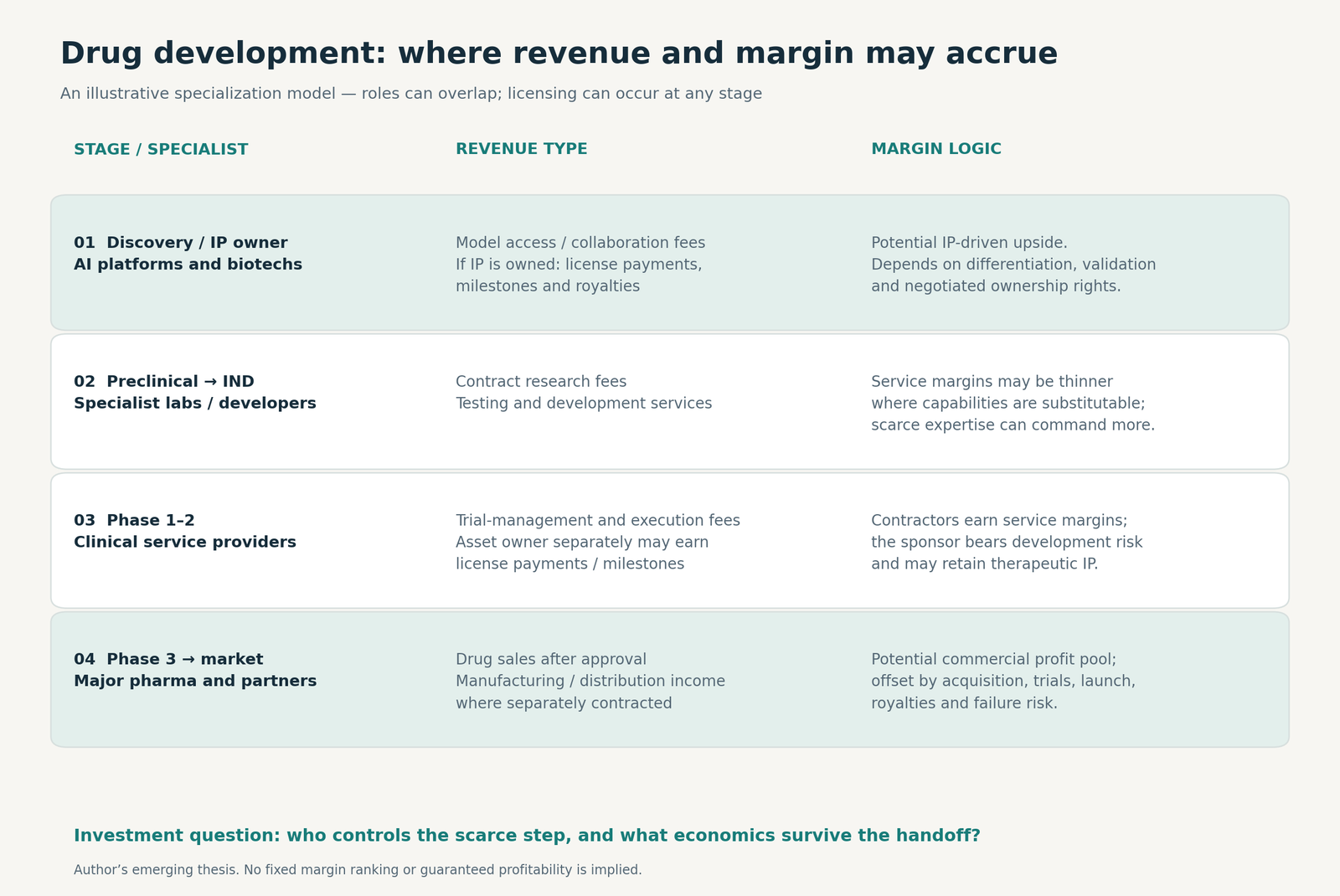
We already have contract research organizations, specialist manufacturers, licensing transactions and large pharmaceutical companies buying programs developed elsewhere. That is not new. My emerging thesis is that AI could deepen this division of labor, and make more of the pipeline economically viable as separate, stage-focused businesses.
At the discovery end, companies such as Google DeepMind and its related drug discovery business, Isomorphic Labs, are developing dedicated biological models. Anthropic is also bringing frontier AI into life sciences, including research reasoning, biological data analysis and scientific workflows. These are different capabilities, but both illustrate the growing role of AI companies in the research process. [3, 7]
From there, a developer could own or license promising IP and contract specialist businesses to carry out preclinical work, assemble the package for an investigational new drug application, and support the studies needed to begin human testing. Other organizations could specialize in Phase 1 and Phase 2 execution, working with the sponsor responsible for the program.
After meaningful clinical evidence, the program might be licensed or sold to a major pharmaceutical company with the balance sheet, regulatory experience, manufacturing capabilities and commercial infrastructure to fund Phase 3, seek approval and support market distribution.
That is one possible pathway, not a fixed sequence. Some programs will be partnered earlier. Others will remain integrated. A contractor performing a trial is also not necessarily the owner of the drug or the sponsor bearing its development risk.
But the economic implication is substantial. A biotech company may be built to reach a specific, valuable handoff rather than to finance and operate the entire journey from discovery to commercial distribution.
For investors, that changes the unit of analysis. What stage is this business designed to complete? What evidence does the next buyer require? Who owns the IP, who bears the cost of failure, and how much of the eventual economics stays with the current shareholders?
A service company may earn fees without owning a therapeutic. An IP owner may retain royalties and milestones, but depend on someone else's priorities and execution. A discovery platform may generate many candidates and still struggle to capture much value.
Faster discovery alone doesn't answer those questions.
Genomics and the Economics of Smaller Patient Populations
Genomics may be one of the major beneficiaries of this transition. As researchers get better at identifying disease-causing variants and designing interventions against them, the economics of treating smaller patient populations could change. Eventually that may extend to treatments designed around an individual patient's mutation.
There is already a substantial flow of medicines for rare diseases. In 2023, 28 of CDER's 55 novel drug approvals were for rare diseases. In 2024, it was 26 of 50. That is roughly half in each year. It demonstrates how important this area has become, although those figures alone do not establish an accelerating rate of approvals. Nor are all rare-disease medicines genetically targeted or personalized; orphan designation concerns a rare disease, not whether a treatment is custom-made. [9, 10]
A more direct example appeared in 2025, when researchers developed and administered a personalized CRISPR base-editing treatment for an infant with CPS1 deficiency. The treatment targeted the child's particular mutation. It was an experimental treatment for one patient, not a broadly approved product, but it demonstrated that this kind of development is possible. [11]
The economic opportunity I see is reuse. If a developer can reuse a delivery system, manufacturing process, experimental methods and, where regulators permit, parts of the supporting development package, changing the genetic target may require less work than building an entirely new program. AI could help accelerate target analysis and design, while specialist laboratories establish whether the proposed intervention works.
That could make more treatments for very small populations economically feasible. Dramatically lower total development costs remain a thesis to be tested, however, and lower development costs do not automatically mean lower prices for patients. Delivery, safety testing, manufacturing and clinical evidence still have to be paid for. The companies that make this process repeatable may capture more value than those that simply identify the next target.
Where the Margin Goes
Changes in the development cycle also change where margin is allocated. If discovery becomes faster and candidates become more abundant, competition could reduce what buyers pay for an unvalidated candidate. Part of the value may migrate toward whoever controls the scarce next step: biological validation, delivery, clinical execution, manufacturing or access to the market.
That does not mean discovery platforms cannot retain attractive margins. A platform with differentiated IP, superior evidence or exclusive data may have substantial bargaining power. The point is that lower cost at one stage does not tell us who captures the saving.
A contractor may earn a service margin. An IP owner may negotiate upfront payments, milestones and royalties. A pharmaceutical company may absorb later-stage development risk and retain the commercial economics. Investors need to understand both the cost of advancing the program and the bargaining power at each handoff.
Does the company merely participate in the pipeline, or does it control a bottleneck that allows it to retain an attractive share of the economics? That question becomes more important as the industry specializes.
Five Questions I Would Ask Today
The five questions in my original article addressed burn rate, institutional sponsorship, partnerships, trial financing and the competitive landscape. I would still ask them. But I would now frame the discussion around the company's place in this changing pipeline.
1. What is the biological claim, and what has actually been demonstrated?
I want to understand what the company believes about the disease and why its proposed treatment should work. Then separate the prediction from the evidence. What has been shown in a laboratory, in animals, or in patients? What result would cause management to abandon the thesis? An impressive model output is a starting point. It is not proof of therapeutic success.
2. What does the company own that others cannot easily reproduce?
It might be therapeutic IP, proprietary experimental data, delivery technology, manufacturing know-how or a laboratory process that produces better information with each cycle. I expect AI companies such as Anthropic and Google to compete increasingly at the discovery and IP end of this market. Whether they capture licensing income will depend on what they own and how their partnerships are structured. It might also be a specialized development capability that customers are willing to pay for repeatedly. Access to an AI system, by itself, tells me very little about the durability of the business. I want to know where the advantage resides and whether the company can capture its value.
3. Who is backing the company, and is there sufficient runway?
This is where my Three Trigger Thesis is particularly important. Elite venture participation, sequential institutional validation and substantial institutional capital commitments provide observable evidence that knowledgeable outsiders have put capital at risk. They can help reduce management, product and financing uncertainty. In biotech, however, backing does not substitute for clinical evidence, and an investor's name does not guarantee another financing round. I want to know who invested, at what stage, what they validated and whether the cash available can carry the company through its next meaningful milestone. [8]
Runway has to be measured against the work, not simply against the calendar. If the company needs positive Phase 2 data to attract a partner, does it have enough money to obtain that data, including a realistic allowance for delays? Otherwise shareholders may be financing the right science through the wrong capital structure.
4. Which stage is this company built to complete, and who takes it from there?
Is this a discovery platform, a preclinical developer, a clinical-stage asset owner or a service business? What is the intended handoff: an IND-ready program, early human safety data, proof of concept, or something later? I want to see a credible route to the next partner or buyer. A planned licensing transaction is not financing until there is a counterparty and an agreement. The development plan must also cover what happens if that handoff takes longer than expected.
5. What economics remain for investors after the handoffs?
A valuable drug does not automatically produce a valuable investment in every company that touched it. We need to understand license obligations, royalties, milestone payments, contractor costs, future dilution and the capital still required. Who pays for Phase 3? Who controls development after licensing? What happens if the partner shelves the program? And does the competitive landscape leave room for an attractive commercial outcome by the time the product reaches patients?
In the specialization model I am describing, the discoverer may retain licensing income if it owns the IP. Preclinical and clinical contractors may earn thinner service margins where their capabilities are readily substitutable. Major pharma may capture a substantial share of the commercial profit because it supplies later-stage capital, regulatory expertise and market access. But it also pays for the program and bears the risk that development fails. Margin follows ownership, scarcity and bargaining power, not simply the stage number.
Where I Think This Leads
In 2015, my emphasis was that computation was changing the efficiency of biotech research. Today I think the more consequential possibility is that it changes how the industry organizes that research, finances development and distributes the resulting value.
The timeline helps explain why. A shared genome reference, stronger image interpretation, useful protein structure predictions and generative protein design expand what researchers can attempt. The commercial outcome still depends on biological validation, execution and capital.
If the pipeline becomes more specialized, we should expect different investment opportunities at different stages. Some businesses will earn service revenue. Some will own programs intended for licensing. Others will supply scarce data, delivery systems or manufacturing capabilities. Their risks and capital requirements will differ, even when all are described as AI biotech.
That is the change I am watching. More powerful discovery tools may create more candidates. The investment opportunity is in understanding which businesses can advance them, where the bottlenecks remain, and who ultimately captures the economics.
Source Notes — Editorial Reference
Original article: Biotech Investing — Five Basic Questions to Ask (also preserved in the Thesis Archive)
- [1] NHGRI — Human Genome Project Fact Sheet; completion and remaining gaps
- [2] Microsoft Research — ImageNet milestone
- [3] Google DeepMind — AlphaFold history, applications and experimental connections: AlphaFold; Enabling high-accuracy protein structure prediction at the proteome scale; AlphaFold reveals the structure of the protein universe
- [4] Watson et al., Nature — De novo design of protein structure and function with RFdiffusion
- [5] Zambaldi et al. — De novo design of high-affinity protein binders with AlphaProteo; research preprint
- [6] FDA — First gene therapies approved for sickle cell disease
- [7] Anthropic — Claude for Life Sciences
- [8] Karl B. Douglas — The Three Trigger Methodology
- [9] FDA — CDER rare-disease approvals in 2023
- [10] FDA — New Drug Therapy Approvals 2024
- [11] NIH — Personalized gene-editing treatment for an infant with CPS1 deficiency
Editorial Note
This is a retrospective and an evolving investment thesis. The original article remains a separate historical record. The proposed increase in stage specialization is the author's interpretation, not a claim that the entire industry has already adopted this structure.
[12] Why I use “Edited by”
The articles I produce are based on my ideas, theses and outlines. For proper disclosure, I use the term “Edited by” rather than “Written by” when AI has been used for research, fact checking, and sentence generation or modification.